Contact Us

Questions? Comments? Concerns? Suggestions? Submissions? Shout-outs?

Whatever you want to tell us here at Mikey Does Cosplay, we're always happy to hear your thoughts and feedback!


123 Street Avenue, City Town, 99999

(123) 555-6789

email@address.com


You can set your address, phone number, email and site description in the settings tab.
Link to read me page with more information.

Cryptobiology

Polycerus

Michael MacWolff

IMG_7692.JPG

Cryptologic Name: Canis multicerus
Planar Origin
: Olympia
Habitat: Highly varied, depending primarily on their progenitors
Diet: Omnivorous; primarily eat meat but will also consume grains and vegetables

Appearance & Morphology
Polyceri are a diverse group of canines possessing multiple heads. Three-headed individuals are the most common morphs, with two-headed dogs being somewhat rarer. Other multiples are possible but exceedingly rare; to date the highest known head-count on a single individual is thirteen. Because the two and three-headed variants are more common, they are commonly called “orthrus” and “cerberus,” respectively. These names come from the first known records of polyceri in myths of ancient Greece.

These creatures’ origins are purely magical, meaning that they are generally born from single-headed dogs under specific conditions. Those conditions, however, are not entirely clear to us at present and may, in fact, simply be a random “mutation.” From a biological standpoint, polyceri are not a distinct species from its canine progenitors (nor from other polyceri with different numbers of heads) as they can procreate with other dogs with any number of heads. We do know that multi-headed parents will more often produce multi-headed offspring but are not guaranteed to do so; breeding a pair of cerberi has yielded single-headed puppies on many occasions.

Aside from the extra head(s), polyceri physically resemble their single-headed counterparts in all other respects; they inherit coloration, size, and shape based on their genetics. Thus, an orthrus born from a pair of golden retrievers will simply look like a golden retriever with an extra head.

Magical Abilities
Polyceri only have a singular known magical ability: they can see things that are invisible. This includes creatures that are intrinsically or can become invisible, as well as magic spells and objects which turn things invisible or conceal objects or living things though other methods. This even includes beings that are entirely incorporeal, such as phantoms. Thus far, no method has yet been devised to “fool” a polycerus’s eyes. This ability, combined with their naturally keen senses of smell and hearing, mean that polyceri make very effective guard dogs.

It should be noted that magical hounds (such as coin-sithe, hell hounds, etc.) are also capable of producing polyceri and these multi-headed hounds retain any magical abilities of their parents.

Behavior
Much like their appearance, these creatures are dogs through-and-through in terms of behavior as well. They are social creatures, moderately intelligent (though much of this is based on breed), easily trainable, and generally form strong bonds with their companions.

Temperaments in polyceri can vary widely, with trends following those of their breed fairly closely, but quirks tend to be more pronounced compared to their single-headed relatives on account of having multiple dog brains at work. Thus, multi-headed chihuahuas will likely be even yappier and more excitable, border collies will have greater herding tendencies, etc. Each head also seems to have a distinct personality, though they tend to align fairly closely. Furthermore, all the heads work in tandem to control the creature’s body collectively, which tends to make them a little more derpy when the heads don’t coordinate properly; you tend to see this the most in puppies, as they generally learn how to coordinate better as they age.

Field Notes

  • It’s worth noting that “dog” is used as a fairly wide classification when describing the species that can become polyceri. Any creature in the biological family Canidae can produce a polycerus, which includes domestic dogs, wild dogs, jackals, raccoon dogs, all species of wolf, and all species of fox. It addition, as stated above, magical canines can also produce polyceri, so it would appear that either the overall morphology of canines, or perhaps simply the idea of canines as a group of animals is what gives rise to these creatures.

IMG_7694.JPG

OOC Corner
Polyceri come from Greek mythology. Like many creatures in Greek mythology, they are not necessarily a populous species, but individual creatures of note. These are based on Cerberus, the 3-headed hound of Hades who guards the entrance to the underworld, and Orthrus, the 2-headed hound who was famously slain by Heracles.

Mimic

Michael MacWolff

IMG_0829.JPG

Cryptologic Name: Arca incubo
Planar Origin
: Materia
Habitat: Anywhere inhabited by humans
Diet: Carnivorous; they will eat almost any living creature, but seem to have a particular taste for humans

Appearance & Morphology
Mimics are fairly easy to describe in appearance, but it is a good deal harder to explain their morphology. The easy explanation is that a mimic is a container with a lid of some sort, which opens to reveal a maw with sharp teeth and a long, muscular tongue. The mimic’s true body is still not entirely understood, because we know that they do not produce the container, rather they inhabit it, much like a hermit crab inhabits shells left behind by other animals. It is accurate to say, however, that when a mimic inhabits a container, that the container becomes a part of the mimics body; they are completely inseparable by any means we yet possess.

Mimics are indistinguishable from normal containers as the vessel it inhabits remains entirely unchanged by its inhabitant. As such it can be extremely difficult to identify a mimic until you’re close enough for it to attack you. This adds to the dangerous nature of these creatures, however, mimics have been known to shudder in anticipation of a meal, so if you’re lucky you can catch the subtle movement or sound before you get close enough for it to grab you.

Magical Abilities
While they don’t possess a great deal of active magical abilities, they are still rather dangerous as mimics are virtually indestructible from the outside, being essentially immune to both physical and magical assault.. As such, the only way to kill a mimic is to target the fleshy insides while its mouth is open, which consequently is the most dangerous time to be near one of these creatures.

In addition, Mimic saliva also has some unique properties. It is an incredibly potent solvent, able to dissolve most organic matter, however inorganic materials such as glass, stone or metal remain entirely unharmed by the substance. Additionally, when exposed to oxygen it becomes incredibly viscous and sticky. This saliva is used as an ingredient for several potions, but because of the way it reacts to oxygen and its potency as a solvent, it needs to be stored under very particular conditions.

Behavior
Mimics are the epitome of camouflaged sit-and-wait predators. They will remain motionless for weeks at a time, waiting for a meal to come by. While mimics do not have eyes or other visible sense organs on the outside of their body, they can sense subtle vibrations around them, primarily through their contact with the floor. This allows them to strike with surprising precision with their long, flexible tongues. when prey comes into range. This also means that flying creatures such as birds and bats are generally ignored by mimics.

Despite having no outward appendages, mimics can and do move around. They achieve locomotion by using their tongues to drag themselves around in a similar fashion to bivalves

Mimic reproduction is a subject about which we still know very little. My best guess is that they reproduce asexually, as I’ve never observed two mimics interact in such a way that would suggest procreation, nor have I found any evidence that mimics have distinct sexes. What we do know (or presume, at least) is that some act of spawning is required, as juvenile mimics only seem to appear when an adult mimic is in the vicinity. We also know that a suitable vessel is required, as the container itself is not generated by the mimic upon its birth.

What is most puzzling is the actual mechanism involved in reproduction; thus far there has been no observable interaction between the adult mimic and the spawn. Perhaps some sort of spores are released that are too small to be seen or are entirely invisible. Alternatively, as a magical creature it is entirely possible that a mimic simply wills a nearby container into becoming another mimic. An alternative theory has also been proposed, whereby the container itself is responsible for its transformation into a mimic, rather than the mimic creating an offspring of its own will, though this theory seems the most unlikely to me.

Field Notes

  • The natural properties of the mimic have led some to attempt to tame these creatures for the purpose of protecting their valuables. This is a rather effective strategy in theory but a difficult one to put into practice as mimics are not known to be overly intelligent creatures and generally attempt to eat any living creature they come into contact with. This is not to suggest that it can’t be done, only that it requires a great amount of both patience and skill to train one, and even once tamed you could still lose an appendage if you’re not careful.

  • If you’re concerned you may have stumbled across one and don’t want to get too close for the mimic to reveal itself, a good strategy is to toss something at the container to see if it elicits a reaction; most mimics are voracious enough to react even if the item they’ve been struck with is inedible.

  • While we don’t know how mimics reproduce, we do know that they can inhabit new vessels if they so choose. This is often achieved by climbing into a larger container, transferring to the new container (though how exactly that occurs we don’t know) and then spitting out the old container once the transfer is complete. In this way they further resemble hermit crabs.

  • It is unclear why mimics most often end up inhabiting treasure chests and similar boxes, though the hinged opening and sturdy construction do seem to lend themselves rather well to a mimic’s anatomy. Despite this trend, mimics have been known to inhabit a wide variety of containers of different shapes and sizes. I’ve seen mimics inhabit anything from a jewelry box to a trash dumpster (the latter was, as I’m sure you can imagine, quite terrifying, simply given its size). In an attempt to better understand mimic anatomy, I have kept a mimic in close proximity to a variety of transparent containers, hoping that it would spawn a baby mimic in one such that I could observe the anatomy from the outside, but thus far I have been unsuccessful in this endeavor.


OOC Corner
Mimics are a creature which make an appearance in a variety of fantasy media, the most well-known instance being Dungeons & Dragons.

Minima Identification: Gjøltrolds, Gnomes & Smurfs, Oh My!

Michael MacWolff

I was recently sent an inquiry into the genealogical relationships and identification of gjøltrolds, gnomes, and smurfs. While I haven’t done a great deal of personal study on any of these species, I’m always one to encourage cryptozoological intreset and exploration, so I compiled some information to help answer these questions! Eventually I’d love to do a little more personal research on these three distinct creatures and put together field guide entries for them.

Before we get started I do want to make a note on gjøltrolds. While commonly referred to as “trolls,” I’m using their proper name so as not to confuse them with jöthurs (the large, grotesque, humanoid creatures that are closely related to orcs, jötunn, ogres, and goblins), which are also commonly referred to as trolls.

trolls-2-e1512602728338.jpg
1183613.0.jpg
outdoor-garden-decorated-with-gnomes.jpg

Taxonomy

There are a wide variety of small humanoid creatures, and not all of them are particularly closely related from a genealogical/taxonomic perspective. In the case of these three particular species, two of them are much more closely related than the third. Gnomes are actually members of the faerie phylum, meaning they are native to the fae realm along with faeries, sprites, leprechauns, and many other magical species (including many small humanoids much like themselves). Smurfs and gjøltrolds are both native to the material plane, and are very closely related, being two species within the same genus, Minima.


Identification

While at first the task of differentiating between these three species of small humanoid creatures may seem fairly straightforward, there are quite a few similarities and given the variation between individuals, particularly among gjøltrolds, it can sometimes cause some confusion.

  • Gjøltrold: The most distinctive feature of a gjøltrold is the magical gem that grows in their belly button; these gems contain magical energy specific to the individual and that energy can be accessed by the troll. This feature is only seen on this species, so if you see a belly-button gem, you definitely have a troll. Most trolls wear clothes, though, so you may not be able to see their gem if their midriff is covered. Gjøltrolds’ hair is another hint at their identity. Many of these creatures have brightly-colored hair in fairly wild styles. These creatures can actually control their hair as though it was an appendage, so that is another surefire indication that you’re dealing with a gjøltrold.

 
troll_dolls_a_l.jpg
 
  • Smurfs: Their blue skin is a good starting point but many trolls have blue skin as well, so it’s not a surefire method of identification. Smurfs one main morphological feature that makes them distinct from the other species in question, their stubby tails (similar to a rabbit’s).

 
Generic_Smurf_Profile.jpg
 
  • Gnomes: Gnomes are most easily identifiable by their beards. Neither trolls nor smurfs are known to grow facial hair (with the exception of the progenitor smurf, aka “Papa Smurf,” but because gnomes do not have blue skin, that should be an easy distinction.) In gnomish culture, beards are as symbol of age and status and as such are almost never cut, so the length of a gnome’s beard can give you an indication as to their age. And yes, female gnomes also grow facial hair as well, though culturally they tend to be a bit freer in their trimming and styling than the men. In addition, of the three species we’re discussing, they are the only ones to have a full set of 5 digits on each hand (assuming they haven’t had any unfortunate accidents), whereas gjøltrolds and smurfs only have 4.

 
gnomes+1.jpg
 

While these notes do outline the morphological differences between these three species, I feel like I would be remiss not to mention the fact that all three of them are highly intelligent and can communicate. They do have their own languages but many who live on earth also know local human dialects, so when in doubt, you can always try asking them.

Ursa

Michael MacWolff

IMG_5523.JPG

Cryptologic Name: Grimm ursus
Planar Origin
: Remnant
Habitat: Forest/Tundra
Diet: Omnivorous

Appearance
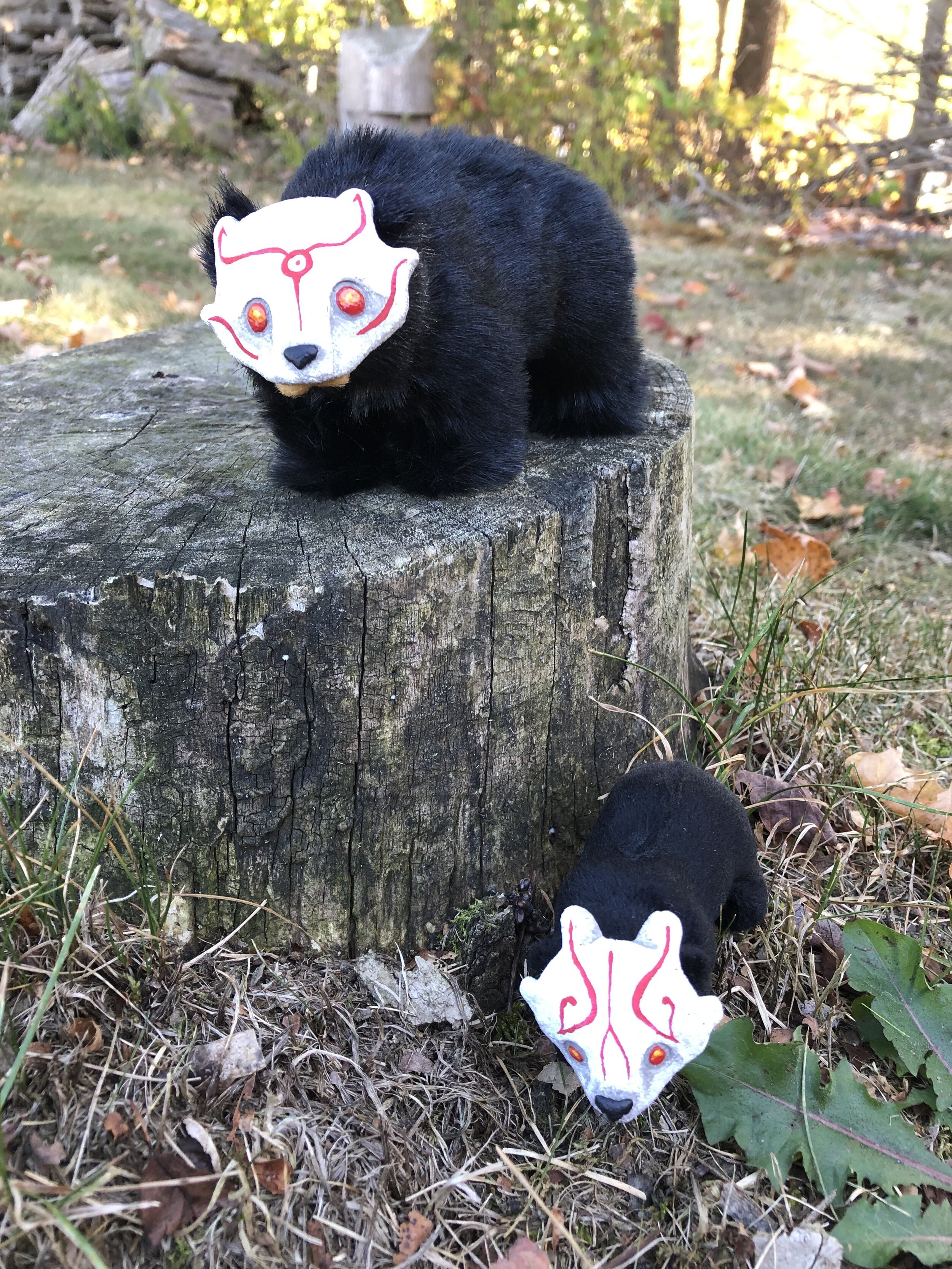
Ursai are large, bear-shaped creatures of the grimm genus. These large animals have a similar appearance to their fellow grimm with thick black fur, fiery red eyes, and white bone masks with distinctive red markings on them (though in rare cases grimm have markings in other hues). Adults can reach a size of up to 10ft. from snout to tail, and a shoulder height of about 6ft. Like nonmagical bears, they can stand on their hind legs, which means the larger individuals can reach a height of about 16ft. when standing upright. Despite their size, they are much lighter in weight than their nonmagical counterparts, generally weighing between 250-300 lbs. This is quite a stark difference when compared to the brown bear, which are of a similar size, but can weigh up to 1200lbs.

Magical Abilities
Ursai’s most well known magical trait is that their hides have anti-magical properties. This takes shape in several ways, but most significantly means that they are highly resistant to magical assault. In addition this means that magical barriers also have little effect on these creatures, as their coats allow them to pass through force fields, or otherwise nullify ambient effects of spells that would influence them in other ways (e.g. concealing charms would not render an object invisible to the ursa).

In addition to their natural magical resistance, ursai also have the ability to consciously travel into the dreams of sleeping/unconscious creatures in their vicinity.. While this might sound like a rather terrifying prospect, they are actually far less dangerous to encounter in dreams than they are in the physical world. In dreams, ursai manifest as bear-shaped beings of golden light and can communicate with those who are dreaming, though this communication is difficult to classify. They do not speak, per se, but they can convey and understand ideas and concepts through other methods. While travelling into dreams their bodies in the physical world become incorporeal; they do not disappear entirely but the physical form becomes translucent and mist-like, and the markings on their masks will glow brightly on their ethereal form.

Behavior
Ursai generally travel in groups, known as “sleuths,” of about 4-8 individuals. These sleuths are most commonly comprised of a single mating pair and their offspring, but sometimes ursai will “adopt” others into their sleuths when they encounter loners. While these creatures are usually rather docile towards other animals, they are fiercely protective of other members of their sleuths. Ursai have sharp claws, strong jaws, and are incredibly agile despite their size, making them exceedingly dangerous animals to approach unprepared, particularly given their natural resistance to magic. These creatures are generally very distrustful of humans and will often attack a conscious human even if unprovoked.

Field Notes

  • Given the natural anti-magical properties of the ursa’s hide, it is a widely sought-after material in the magical community. The hide retains its magical resistance even after being removed from the animal, so its fur is often fashioned into expensive protective garments for mages. The hunting of ursai took a great toll on these creatures and their Terran populations dwindled considerably, but now it is illegal to hunt these incredible creatures and their populations are starting to recover. That of course doesn’t mean that there is not considerable profit to be made on the black market by poaching them, but at least protections are in place and the animals are doing better as a result.

  • The fact that ursai are seemingly so intelligent gives rise to the question of why they tend to be so aggressive toward humans when encountered in the wild. It is generally believed that this stems from the above point that they were hunted nearly to extinction, and this intelligence would likely allow them to communicate this mistrust in humanity to future generations of their species in an effort to protect them from the threat.

  • It does seem that by interacting with people first in dreams, ursai can safely gauge people’s intentions, and will react on the physical plane accordingly when the human in question returns to consciousness. Most people have little control over their dreams and ursai, being dreamwalkers, are likely knowledgeable in how to interpret different aspects of a person’s dreams in order to gain a true understanding of their character and intentions as they explore and interact with the dreamer, even when said dreamer is attempting to hide something.

  • In my own fascination and desire to learn more about these creatures, I devised a plan to befriend a sleuth that is known to live in Yellowstone National Park. I brewed a special potion which causes the drinker to immediately lose consciousness with the intention of finding the ursai and drinking the potion in their presence such that they could meet me, and hopefully understand my intentions well enough to allow me to interact with them in the waking world (preferably without mauling me to death). While this plan overall was fairly solid, I did not anticipate the creatures’ degree of wariness, and so it took more than one try to get the creatures to trust me. Fortunately they seemed to understand that I was not a threat to them, so they didn’t kill me outright, but apparently my desire to study them was something they were tenuous about. Ultimately I ran out of potion after my third attempt, and before I had the opportunity to brew more, the sleuth found their way to my campsite. I was forced to rely on somewhat more drastic measures, recognizing the opportunity and potential that my life may be in danger if I remained conscious, and so I ended up knocking myself out by slamming my head into a picnic table. Somehow despite my possible concussion, that interaction was the final breakthrough with the ursai and upon waking I finally was granted the privilege of spending time with these amazing creatures in the waking world.

    • One new discovery I made is that they can use their abilities to half-shift into a dream state when they wish to communicate with each other. When this happens, the markings on their masks glow, but their bodies do not fade away like when they enter someone’s dreams. I was very curious about this and wanted to find a way to communicate with the creatures more easily without having to lose consciousness to do so. While I am still doing research on how I might achieve this, the time I spent with the sleuth has earned me their trust. When I’m ready I will certainly be visiting them again, and they made it clear that I will always be welcome among them.

ursa glow.jpg

OOC Corner
The Ursa is a type of Grimm, which are creatures from the animated series RWBY by Rooster Teeth Animation Studio.

Cù-Sìth

Michael MacWolff

IMG_5552.JPG

Cryptologic Name: Sylva Canis
Planar Origin
: Fae
Habitat: Prefer temperate meadows and forests
Diet: Decomposer; only consumes dead material

Appearance
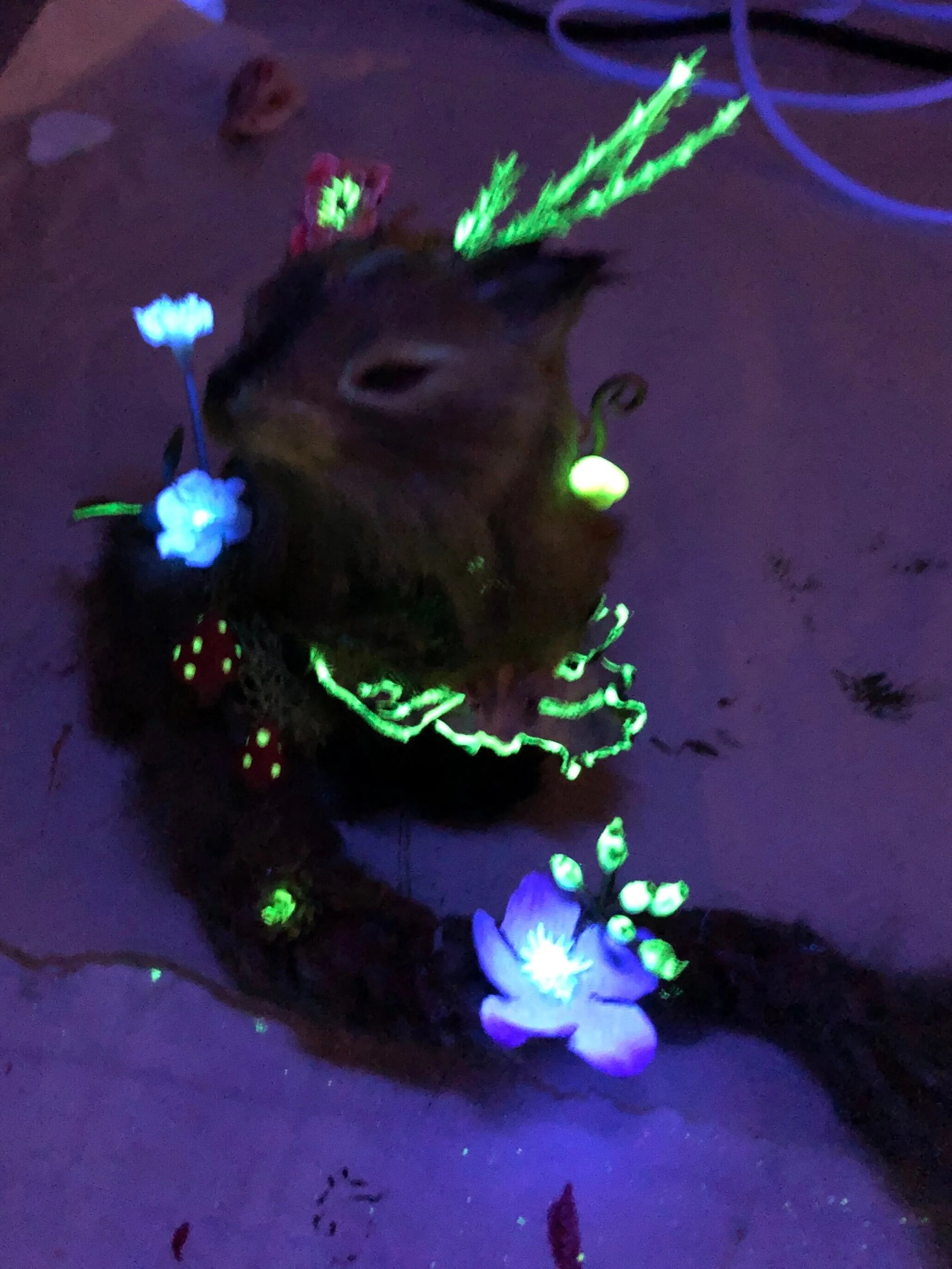
Coin-Sìth, also known as “mossdogs” or “faerie dogs,” are large canines who resemble either wolves or foxes in overall body shape, and have mottled green and brown fur and long, braided tails. The vulpine (fox-shaped) coin-sìth are more commonly seen in the Americas, while the lupine (wolf-shaped) variant are more commonly seen in Europe and western Asia), A variety of mosses, wildflowers, mushrooms, other plants grow in the canine’s fur.

Magical Abilities
The cù-sìth is strongly associated with death, given that they consume only dead plants and animals. These creatures are known to predict when living things in their vicinity are close to death, and will howl to indicate this, similar to the wail of the banshee. Their pelts also have the ability to grow all manner of plant and fungal life. These creatures secrete a magical substance from their skin that acts as a fertilizer, causing plants and fungi to germinate and grow much more rapidly than usual. This substance is also particularly good at growing magical flora.

Behavior
While widely feared (particularly in the British Isles) as harbingers of death, these creatures are actually quite docile, inquisitive and playful creatures. While it is true that they tend to bark or howl in anticipation of a living being’s death (similar to the wail of a banshee), they are never responsible for the death itself. They simply feed off decomposing meat and plants, and howl when they sense death approaching. They howl far more often for dying trees, plants, and wild animals than they do for people, but like many magical creatures associated with death, misfortune, and other unpleasant occurrences, they often get a bad reputation through no fault of their own. In truth they are just as much harbingers of life as death; the energy absorbed from the dead plants and animals which they eat fosters the life growing on their coats.

Field Notes

  • As might be expected, these creatures are popular companions for herbologists, as magical fauna seems to grow particularly well in their fur. In fact, many magical plants and fungi would be nearly impossible to cultivate otherwise. Beyond serving herbologists as a growing medium, they also consume dead plant matter, meaning they will happily dead-head flowers and remove dead vegetation without damaging the living plants around them. While not commonly kept as pets, those who do agree that they make for a nice alternative to composting since coin-sìth will faithfully dispose of food waste, even the parts we don’t generally eat like fruit peels and meat trimmings. They do seem less fond of overly processed foods though, so don’t expect them to clean up your leftover Velveeta dip.

  • Because of their knack for growing magical plants and fungi, coin-sith often glow in the dark as a result of the bio-luminescence that is often seen in magical flora.

 
IMG_5505.jpg

OOC Corner
The cù-sìth [koo-shee] is a creature from Irish/Scottish folklore. In the traditional folklore, they are more hound-like than vulpine but I found a whole bunch of these adorable foxes and went ham. They also are generally green but don’t necessarily have plant life springing from all over their fur.

Amustelid

Michael MacWolff

2019-02-18.png

Cryptologic Name: Lutra Gaudium
Planar Origin
: Mithyrea
Habitat: Semi-aquatic; prefer streams, lakes, and ponds in forested areas
Diet: Carnivorous; primarily eat fish, but will also consume insects and small rodents

Appearance
The amustelid, also commonly referred to as the “bliss otter,” morphologically resembles the North American River Otter in both shape and size with two-toned purple fur (darker violet on the dorsal side and a lighter lavender color on the ventral).

Magical Abilities
Amustelid has strong empathic powers that allow them to sense the emotions of living beings around them. In addition, these creatures emanate an aura of joy in their immediate vicinity, which is how they earned the nickname “bliss otter.” These empathic abilities are both passive and active in nature.

While the amustelid naturally emits its aura, giving a faint cheerfulness to any living beings within a relatively small radius, it can also consciously control and focus this power to create a more intense feeling of euphoria in an individual.

Behavior
Bliss otters, much like their nonmagical cousins, are perfectly at home in the water, being strong swimmers and feeding almost exclusively on fish. These creatures are curious and playful but can be fiercely protective of their companions if they sense a threat. Their empathic feedback serves as a good survival mechanism for them, as they are acutely aware when any of the animals around them become frightened.

Amustelids are social animals by nature and appear to need external emotional energy to sustain them. They will often form bonds with a variety of different species in their habitats, particularly if their population is low. Additionally, we know that solitary amustelids are more prone to illness and injury when they don’t have other creatures around to bond with. Forming these bonds with other creatures also augments their empathic abilities; amustelids normally only receive and transmit emotional energy to animals in their vicinity, however when this creature forms a bond with another individual it creates an emotional “tether” which allows the transmission of emotional energy over a much larger distance, possibly an unlimited distance (though further research is required on that front).

Amustelids are also known to be compassionate creatures; they will often use their powers to ease the pain of sick or injured animals in the wild. In addition, they will often focus their power on prey, such that they do not experience fear or pain as they’re being hunted and killed. This may also simply be to make their prey easier to catch but I’d like to give them the benefit of the doubt and believe that it is not an entirely selfish action. This power is also commonly used as a defense mechanism to lull would-be attackers into lethargy and/or disorientation.

Field Notes

  • Amustelids’ name is derived from the word “amuse” and “Mustela” or “Mustelidae,” which is the taxonomic family containing weasels, badgers, otters, and other related species.

  • These amazing creatures are highly sought-after in a number of fields for the use of their powers. Cryptozoologists will often use them (besides to simply study them) to help with the collection and study of a myriad of creatures that might otherwise be too dangerous or skittish to easily interact with. Amustelids are also often found in hospitals and other healing establishments because of their ability to ease pain when they focus their powers. This can be a trying job however, as they can exhaust themselves when they actively focus their powers for extended periods of time. But even without focusing their powers, their elated aura can provide some relief to those suffering.

  • I have my own amustelid companion who I found while hiking near Brandywine Falls in the Cuyahoga Valley National Park. While he was initially skittish I believe he sensed my curiosity and excitement in finding him and eventually came closer to investigate. We spent a good bit of time playing in the river that afternoon and when I eventually started my trek home he followed me. Knowing that solitary amustelids do not fare as well in the wild, and that they require companions in order to thrive, I gladly brought him with me and he has been a member of the family ever since; we call him Anders.

  • Thanks to my strong bond with Anders, I seem to have made an intriguing new discovery about amustelids. Due to the nature of their empathic tethers with people/animals with whom they’ve established a strong bond and the emotional feedback they get from those companions, it would appear that they can establish a bond with someone without ever meeting them in person.
    A few months back I met someone at a convention and we quickly developed a strong connection. While it is certainly a long-distance relationship with us being in two different states we do communicate quite regularly and have become very close. Recently he came to visit and Anders immediately greeted him in a manner quite similar to how he does when Jordan or I are away for a time and come home. It’s as though he’s developed this empathic connection through me. While I cannot say for certain whether he established an actual tether to this person prior to their meeting, the fact that he felt immediately comfortable with this new person when he is generally quite wary of strangers seems telling enough on its own.


OOC Corner
These creatures are a creation of my own! Empathic powers are a trope in a variety of fantasy media, Charmed being one of my favorites! I found this lovely stuffed otter at one of my local thrift stores and decided it was a magical creature then and there. The rest developed from that first connection!