Alebrije
Michael MacWolff
Cryptologic Name: Multacreatura morpastora
Planar Origin: Materia
Habitat: Varied habitats based on morphology
Diet: Omnivorous
Appearance & Morphology
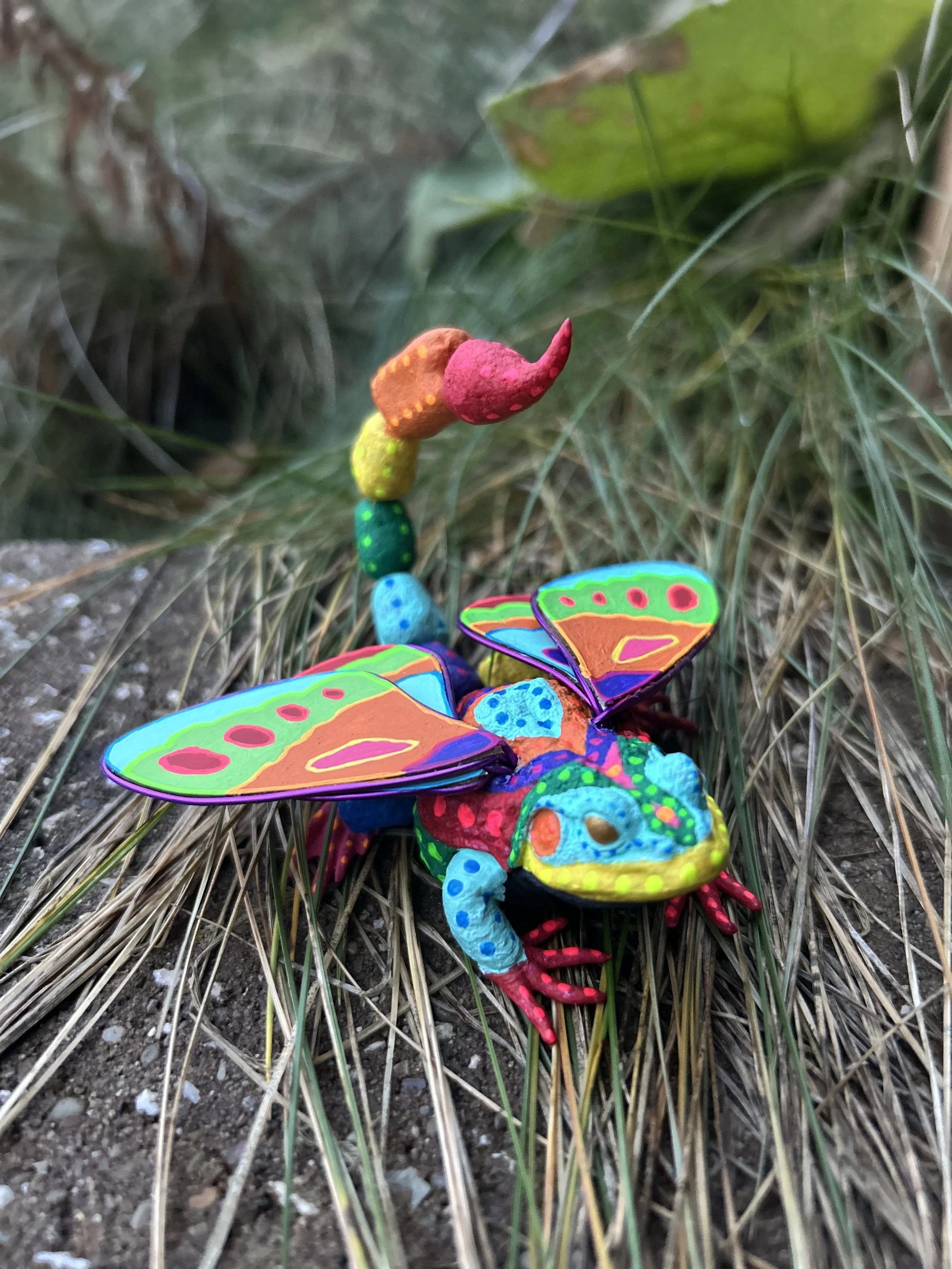
Alebrijes are an incredibly diverse species of magical creature, morphologically speaking. They resemble a variety of nonmagical animals, often having a hybrid anatomy with body shapes, limbs, body coverings, etc. from a variety of different animals. And other individuals resemble a single identifiable creature. The consistent feature of all alebrije is their bright colors and intricate patterns, regardless of whether their body parts are covered with skin, feathers, fur, or scales. Many alebrijes have patterns which illuminate under the right conditions.
Behavior & Magical Abilities
Alebrijes take on characteristics of the creatures whose anatomy they mimic. For example, an alebrije that resembles a squirrel will behave primarily like a squirrel: a tree-climbing creature that likely eats nuts and tries not to get eaten by raptors. This gets more convoluted however, when considering the fact that most of these creatures incorporate physiology from a variety of disparate animals. Take the alebrije pictured above: the central body of a toad/frog, moth wings, and a scorpion tail. Frogs/toads are primarily carnivorous, eating mostly insects and other smaller animals. The venomous stinger would allow it to hunt a wider variety of prey including small rodents and even birds. The moth wings might allow it to fly meaning it could hunt winged insects more effectively, as well as escape predators by taking flight. Frankly this particular combination has more logic to it than some individuals.
Alebrijes do not reproduce sexually but rather spontaneously lay a small clutch of eggs (usually 2-5) once in their lifetime (approximately 5 years old) and raise the young until they reach maturity and lay their own clutch of eggs. Alebrije parents do not pass on their morphology to their progeny, and so raising their young presents a unique challenge when an offspring requires an entirely different source of food from the parent. As such, juvenile alebrijes have a variable survival rate depending on how similar they are to their parents; that said alebrije parents can be quite creative and resourceful when taking care of their young.
Alebrijes are one of very few magical creatures that can pass between worlds at will and are one of the only creatures whose ability to do so is not tied to a specific plane of existence. This incredible power has led alebrijes to be used as spirit guides in various cultures, as they can travel between the material plane and other adjacent planes with ease. An alebrije which forms a strong bond with a human will often travel with them to the realm of the dead when they pass on. They can also accompany us into the dream realm and have been known to lead people out of comas.
Field Notes
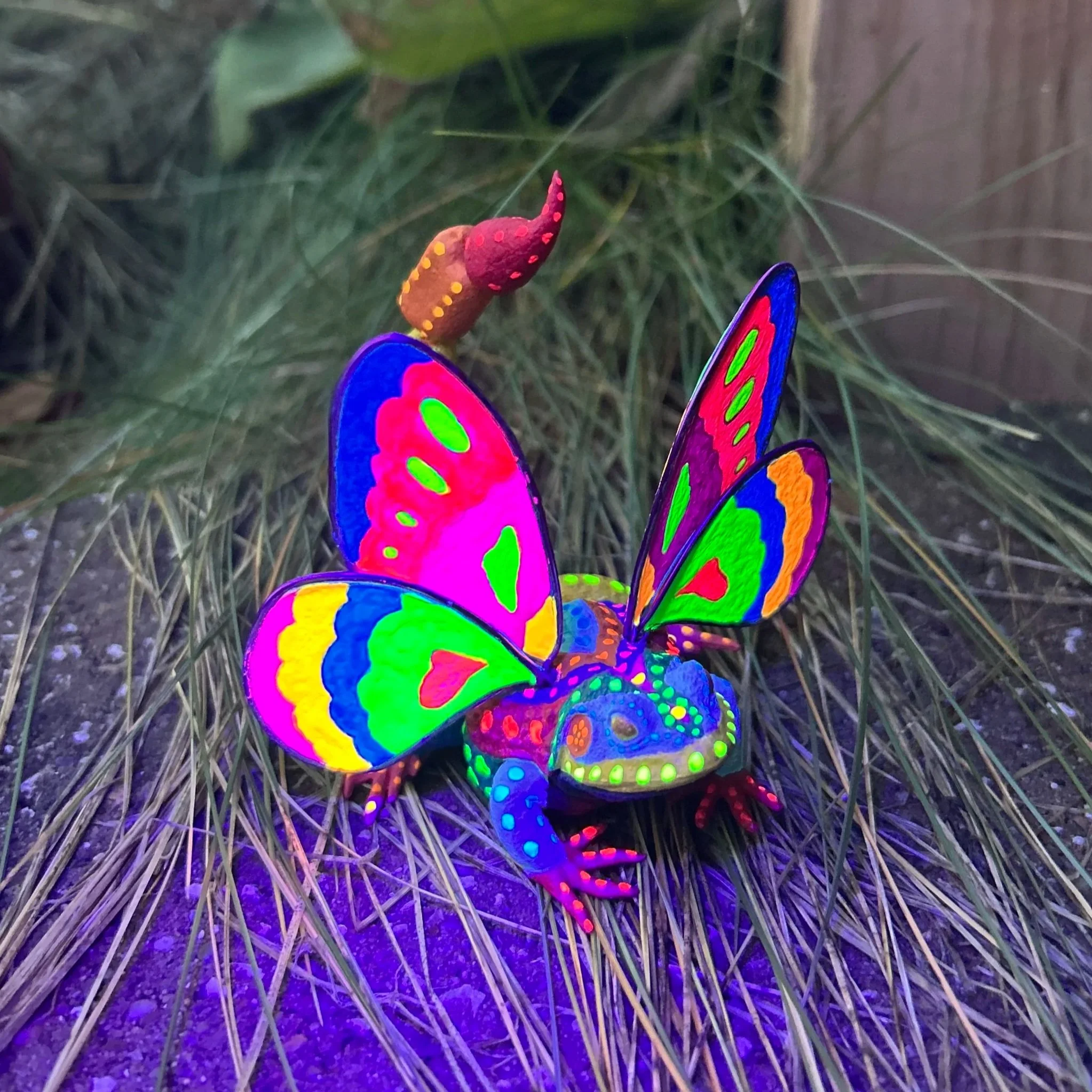
The alebrije pictured here is named Galliard and is a personal companion of mine. He is quite playful and enjoys accompanying me in my dreams. He came with me when I “introduced” myself to the Yellowstone sleuth of ursai by frantically knocking myself unconscious and thought it was great fun despite nearly giving myself a concussion. Galliard has patterns across his body which he will flash both to attract insects which he wants to eat, as well as startle would-be predators. I befriended Galliard when he was 4 so I got to witness him brood. He laid a clutch of 3 eggs and his offspring included a kiwi bird with a rattlesnake tail and hedgehog quills, a small canid animal with a shark head and peacock tail, and something resembling a hawk with a feline head and elaborate moose antlers. He was successful at raising all of them, with a little help on my part when the newborn hawk-cat-moose refused to eat the bugs Galliard tried to feed it and I came to discover it preferred milk in its infancy. Galliard took over when the little creature was about 6 months old and he began teaching them all to hunt insects and the like. All of them have now matured and now live in the wild, each laying their own clutches of eggs.
OOC Corner
Alebrijes are Mexican in origin. Originally created by Pedro Linares after a fever dream, these colorful sculptures are now a prominent fixture of Mexican folk art, particularly in Oaxaca. You can learn more about their history in this article by Mayan Copal. They are also featured in popular media including The Sunbearer Trials by Aiden Thomas, and the Disney film Coco.